
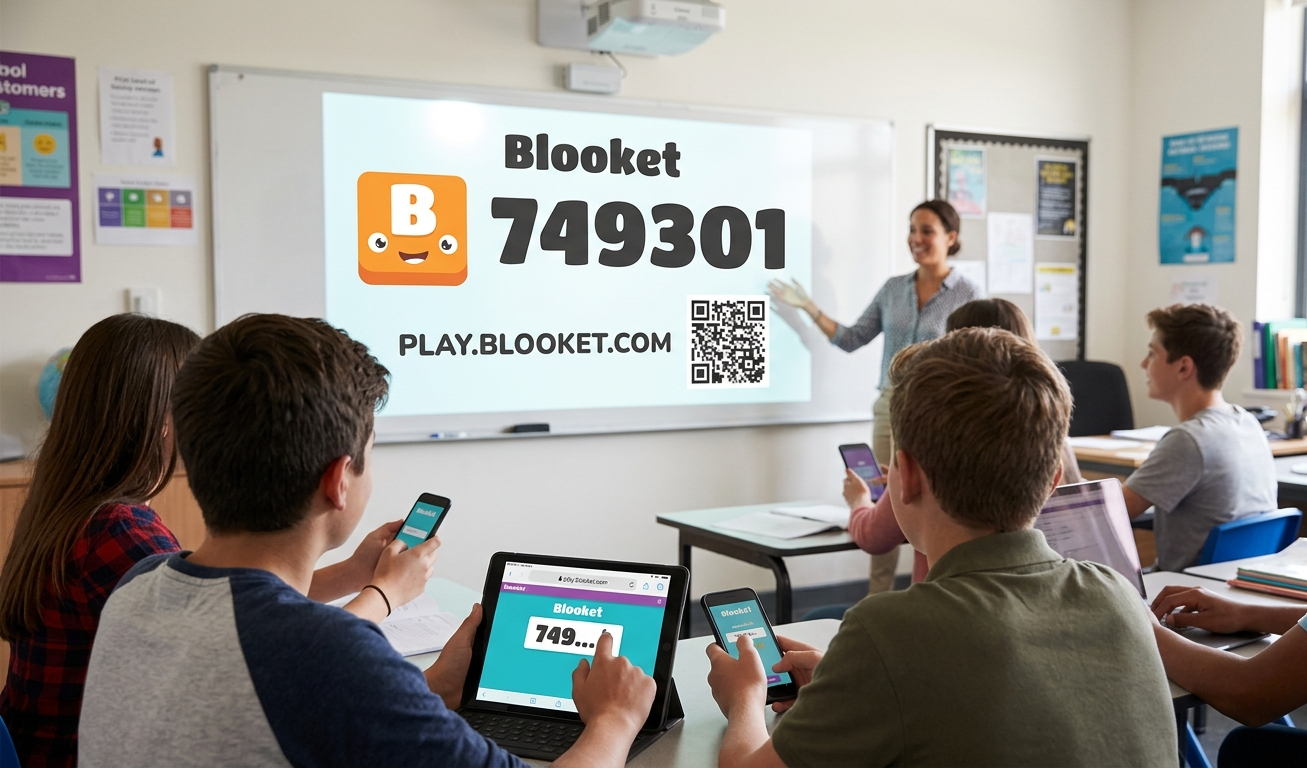
Every day, across millions of classrooms worldwide, a familiar sequence of numbers flashes onto a projector screen. Within seconds, a wave of digital connections surges toward a single destination. To the casual observer, it is simply a “Blooket join code“—a mundane seven-digit number meant to kickstart a trivia game.
Thank you for reading this post, don't forget to subscribe!In reality, that string of digits is a masterpiece of ephemeral data engineering, a psychological transition state. the frontline defense in a high-stakes digital security arms race.
When you strip away the bright colors and animated avatars, the humble join code reveals itself as a fascinating study in modern network architecture and human behavior.
1. The Anatomy of an Ephemeral Key
From a backend development perspective, a Blooket join code is not a permanent password; it is a short-lived cryptographic handshake. Traditional databases are designed for persistence—storing user profiles, high scores, and account details for years. A join code, however, is built to die.
The moment an educator selects a game mode and clicks “Host,” the platform’s server instantiates an isolated virtual sandbox. The seven-digit code is the precise network routing address for that specific sandbox.
Because thousands of separate games run simultaneously, the code prevents cross-traffic interference. It ensures a student in Tokyo doesn’t accidentally drop into a vocabulary quiz happening in New York.
The most brilliant design feature of this code is its total reliance on dynamic memory (RAM). The instant the host terminates the session, the code is completely purged. This architecture explains why the endless lists of “working Blooket codes” found on standard Google searches are fundamentally useless—they are keys to doors that have already ceased to exist.
2. The Gatekeeper: Orchestrating Classroom Security
Because Blooket has evolved into a global phenomenon, the join code has become the primary target for classroom pranksters and amateur script-kiddies. In recent years, developers have had to defend against “lobby injection attacks”—automated browser extensions or python scripts designed to flood a teacher’s screen with hundreds of fake bot accounts in a matter of seconds.
To counter this, the Blooket Joining code system acts as an active gatekeeper utilizing several invisible security layers:
Connection Throttling: The code doesn’t just check if the numbers match; it monitors the velocity of incoming requests. If fifty connections attempt to use the same code within a single millisecond, the system flags the traffic as an automated script and throttles the pipeline.
WebSocket Serialization: Once a student enters a valid code, a persistent, bi-directional communication channel (a WebSocket) is established. This allows the host server to instantly revoke an individual user’s access token without disrupting the other thirty players in the room.
Anonymous Identity Masks: teacher toggles on the “Use Random Names” feature, the join code acts as an algorithmic filter. It strips away user-generated input entirely, automatically assigning pre-approved, safe animal identities to the incoming connection token.
3. The Digital Ante: Cognitive Priming and Transition States
Why does Blooket rely on a manual code input instead of a seamless, automated direct invite or a permanent Google Classroom link? The answer lies in game psychology and user experience design.
The act of looking at a screen, reading a sequence of numbers, and physically typing them into a device serves as a crucial cognitive bridge.
| Phase | Action | Psychological Impact |
| The Display | Code appears on the smartboard. | Signals a shift in classroom energy; grabs immediate visual attention. |
| The Input | Manual entry of the 7 digits. | Moves the student from a passive listener to an active participant. |
| The Lobby | Selecting an avatar (Blook). | Establishes a temporary digital identity and fosters a sense of competitive anticipation. |
In behavioral psychology, this is known as transition state management. The manual entry requirement creates a brief moment of friction that forces the brain to focus. student enters the virtual lobby, their mindset has successfully shifted from a passive lecture listener to an engaged, active competitor.
4. Behind the Scenes: The Silent Data Shuffler
While students are busy customizing their avatars and teasing their classmates in the lobby, the join code is quietly executing a massive data-sorting operation in the background.
If a student enters a code while logged into a personal account, the server utilizes that connection token to pull historical performance metrics, unlocked item sets, and custom avatar arrays. As the lobby fills, the platform’s backend algorithm continuously runs predictive balancing scripts.
If the host chooses a team-based game mode, the system analyzes the incoming data. That streams through the funnel of that single join code. Quietly arranging roster to ensure teams are evenly matched in terms of average response speed and historical accuracy. you watch a string of numbers get typed into a browser, appreciate the silent engineering at play. The Blooket join code is far more than a routine login step.
Frequently ask questions:
1. Do you need a Blooket account to join a game with a code?
No, you do not need to an account to join a live game. You can participate simply by going to play.Blooket.com and typing in the Game ID code, and picking a nickname. However,if you do choose to log into a free account before entering the code.
2. Why is my Blooket Game ID/Join Code not working?
Friends, if you get an error massage saying a code is invalid, it usually happens for one of three reasons:
- The session has ended
- Typo errors
- Late join is turned off